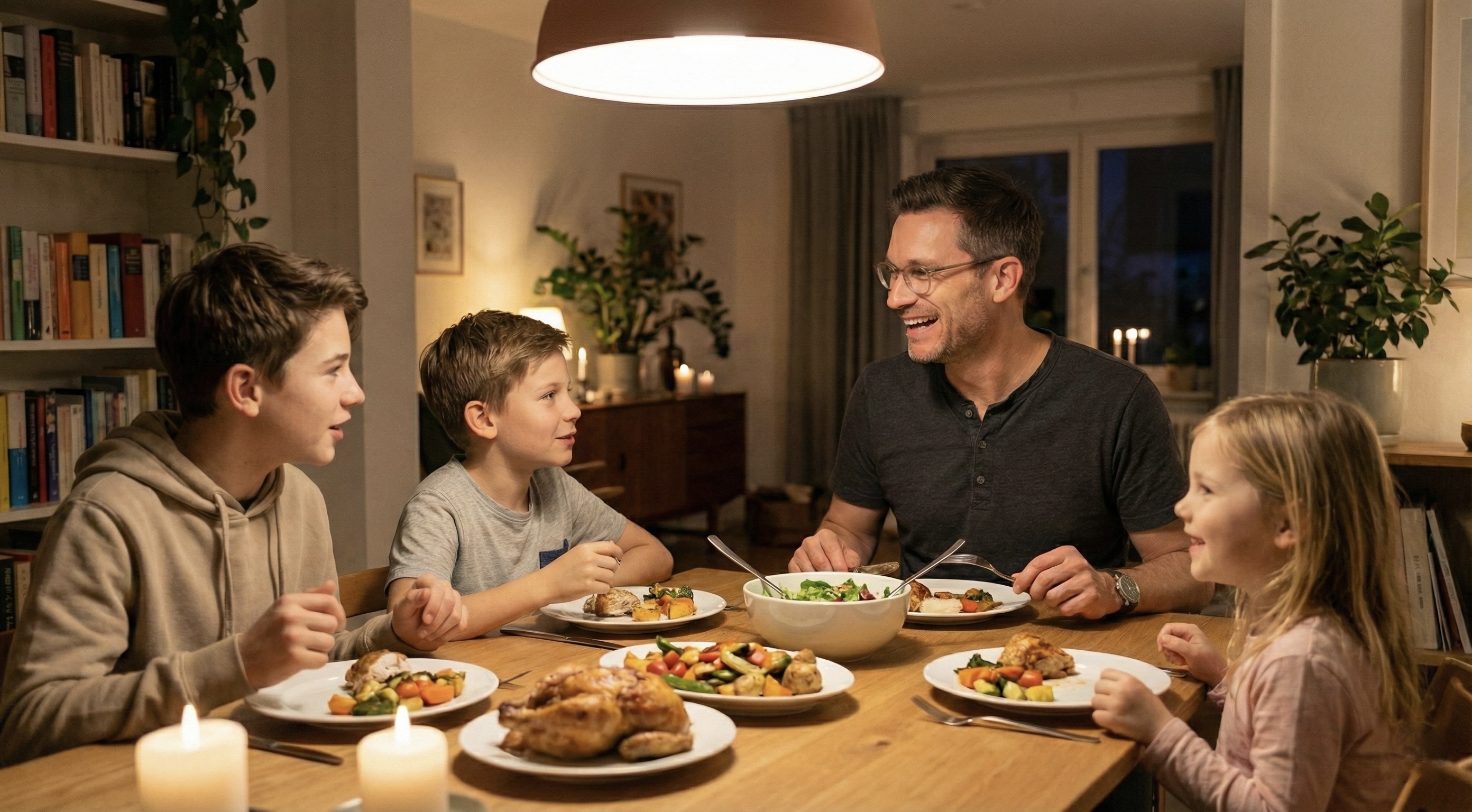
The Dinner Table Opportunity
Here's something I've realized as a parent of three: the windows for real conversation are smaller than you think.
My kids - two sons (14 and 12) and a daughter (10) - are busy with school, sports, homework, screens. The moments when we're actually together, present, talking? They're rare.
Dinner is often the best one.
But here's the problem: by the time you've figured out what to cook, found the recipe, realized you're missing ingredients, and spent 45 minutes stressed in the kitchen - you're too exhausted to be present at the table.
The meal happens. The connection doesn't.
This is why I've started thinking differently about where I spend my time and energy. Every minute I save on logistics is a minute I can spend actually being there.
The Bigger Question
AI is everywhere now - in our phones, our kids' homework, their entertainment, their future careers.
The question isn't whether your kids will interact with AI. They already do.
The question is: are we helping them understand it?
I've spent a lot of time thinking about this. And I've realized that raising kids in the AI age isn't about protecting them FROM technology. It's about teaching them to use it well - and to understand what it can't replace.
A quick note: I'm not a parenting expert or educator. I work with AI daily - helping companies integrate it into their operations - and I'm sharing what I've learned through that lens. This is my personal approach with my own kids. Take what's useful, leave what isn't, and do your own research.
What AI Can't Replace
My kids speak German, French, Spanish, and are learning English. Four languages before any of them have finished secondary school.
Sometimes my 14-year-old asks: "Dad, my phone can translate anything. Why do I need to speak German with you?"
It's a fair question. AI translation is remarkably good now.
But here's what I've learned: translation was never the point. Connection is.
When you speak someone's language - even badly - something changes in the relationship. Trust builds differently. There's a shared vulnerability, a signal that you cared enough to try.
AI can translate words perfectly. It can't replicate the moment when two people really see each other across a cultural gap.
That's what I'm teaching my kids. The human stuff matters MORE now, not less.
Teaching Kids About Attention
Tristan Harris, the former Google design ethicist, taught me something years ago that changed how I parent:
My kids aren't using TikTok. TikTok is using them.
The algorithm knows what makes a 14-year-old keep watching better than the 14-year-old does. That's not scary - it's just the landscape we're navigating.
So we talk about it openly. Not "screens are bad" - that loses credibility immediately because they know it's not true.
Instead: "This app is designed to keep you watching. Do you feel like you're choosing to watch, or like you can't stop?"
I still catch my 14-year-old scrolling at 11pm. That's normal. But he understands WHY it's hard to stop. He's learning to recognize when something is designed to override his choices.
That awareness is the skill. Not perfect self-control - understanding the game you're playing.
Active vs. Passive Screen Time
Here's a distinction I make with my kids constantly:
Using AI to build something is completely different from scrolling TikTok.
Using PlanPlate to plan meals? That's active. You're solving a problem. You're in control.
Watching TikTok for three hours? That's passive. The algorithm is in control. You're the product.
One prepares them for an agentic world. One makes them a resource for advertisers.
We talk about this difference. Often.
The Education Gap Schools Won't Fill
Schools are still catching up. They're preparing kids for a world that existed 20 years ago.
My 14-year-old can solve quadratic equations. He had no idea what compound interest was until I explained it to him.
His reaction: "Wait, the money makes more money? Without doing anything?"
Yes. That's the entire game. And you're 14 and this is the first time anyone's told you.
Schools aren't teaching kids about money. They aren't teaching them about the attention economy. And they aren't teaching them how to work WITH AI rather than compete against it.
These gaps existed before AI. AI just makes them more urgent.
So I'm filling them at home. And tools that save me time - like PlanPlate - give me more capacity to do that.
What I'm Actually Doing
I don't have all the answers. But here's what's working for us:
Curiosity over career paths. I've stopped asking "what do you want to be?" and started asking "what are you curious about?" The job titles will change. The interests underneath won't.
Honest conversations about attention. Not lectures. Questions. "How does it feel when you can't stop scrolling?" Awareness is the skill.
Modeling healthy AI use. My kids see me use AI tools daily - for work, for planning, for problem-solving. They see me in control of the tools, not controlled by them.
Protecting family time. Every minute I save on meal planning, logistics, admin - that's a minute I can spend at the table. AI handles the planning. I handle the parenting.
Teaching the human skills. Languages, reading people, building trust across difference. These are the skills hardest to automate. They're becoming the differentiator.
The Real Opportunity
Something big is happening with AI. And our children can be ready for it.
Not by protecting them from technology. By raising them to thrive alongside it.
Kids who understand the attention economy. Who value human connection. Who know the difference between active and passive screen time. Who see AI as a tool they control, not a force that controls them.
The schools will catch up eventually. But we don't have to wait.
Parents who understand AI can start now - at breakfast tables, at dinner tables, with honest conversations.
And every minute we save on the logistics of life - the planning, the lists, the mental load - is a minute we can spend actually being present with our kids.
That's the opportunity. The dinner table. The conversation. The connection.
The rest is just figuring out what to cook.

Ready to Transform Your Cooking?
Try PlanPlate.ai free and turn any cooking video into a perfect recipe.
Join Beta on iOS
Thanks for reading! Got questions or feedback?
Drop me a line at [email protected]